Skip to content

Space Island

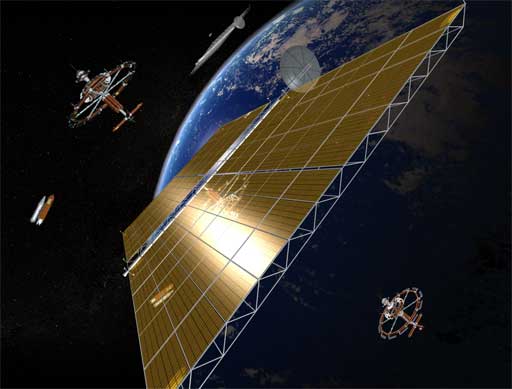
Yesterday the folks from Space Island came to Google to give a presentation. These folks are raising money to build space stations, using shuttle external fuel tanks. They plan to rent space in the stations to manufacturers, researchers, and tourists, and to build solar power satellites, and other orbital construction.

The presentations were much too slick for the tech-heavy Google crowd, making the project seem more like Disneyland meets Las Vegas than a serious space program, but the question-and-answer period quickly got down to hard science and economics as people asked about safety issues, solid rocket booster exhaust, timeframes, and costs. There were good answers for all of the questions, and if they can actually raise the $5-7 billion they want, it looks like they can probably do it, and maybe even make money at it.

Some parts of the plan were less convincing than others. Snagging near earth asteroids for building material sounds like something I wouldn’t want to bet a company on. But that was not presented as a necessary part of the business plan, just something that would be a nice benefit later. The weather control ideas sound a little dangerous. The Mars mission is a long shot. The economics of solar power satellites have interested China and India, where getting power to rural locations is difficult and expensive. But where access to the grid is available, ground based solar arrays might be more economically sound, even though they only produce power 8 hours out of 24 on clear days. It seemed to some in the audience that putting up a lightweight mirror would be cheaper, and putting the heavy solar panels in Arizona or central Australia where clouds are not an issue would make more sense.

Their schedule is certainly intriguing. They hope to have the first modules in space in five years or less.
Categories: Physics, Space.

Tags: , , , ,

Al Gore talks about Global Warming at Google

Al Gore came to Google today, and gave a very slick and well presented talk about Global Warming, presenting in a neat package what is known and accepted by scientists about the subject, and what needs to be done right away. This talk is the basis for a documentary about the subject, coming out next month.

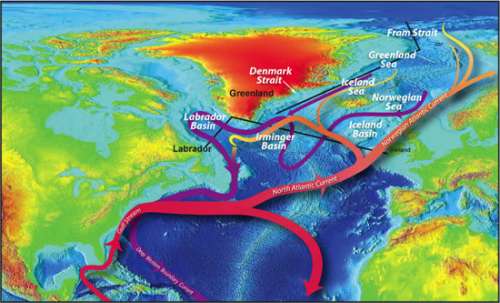
Part of the talk concerned the Meridional Overturning Circulation (MOC) in the oceans, also called the Thermo-Haline Circulation, or the global conveyor belt. The MOC is the system of warm and cold ocean currents that redistribute heat from the tropics to the poles, and is the reason why Europe has a mild climate despite being the same latitude as Alaska. Part of the worry about global warming is that this current might shut down, making Europe much colder and the tropics hotter. Hotter tropics mean more and stronger hurricanes. Colder Europe means France might have the weather that North Dakota has, and similar wine production.

So it was particularly interesting when I returned home and opened this month’s Physics Today, which reports that the MOC has slowed by 30% since 1957.

As global temperatures rise, the warm water currents become warmer. This makes them more buoyant, and they don’t cool and sink as easily when they reach the poles. Added to this is that warm water evaporates faster, and warm air holds more moisture, so there is more water in the air to fall as rain when it reaches the cooler northern latitudes. This extra rainfall dilutes the salt water at high latitudes, making it lighter and less inclined to sink. In June of 2005, Ruth Curry predicted that the extra rainfall would take 100 years to stop the Gulf Stream, unless meltwater from the Greenland Ice Sheet sped up the process. She did not have the recent data showing the 30% change in the current in the last 50 years, or the recent data on the speed of melting of the Greenland glaciers. But I suspect Europe might be a little worried even if it does take until 2105 for the Gulf Stream to shut down.

Their children might live long enough to freeze there. Europe is the same latitude as Mongolia, after all. And a good bottle of Mongolian red wine is hard to come by.

Categories: Environment, Geology, Physics.

Tags: ,

James D. Watson visits Google

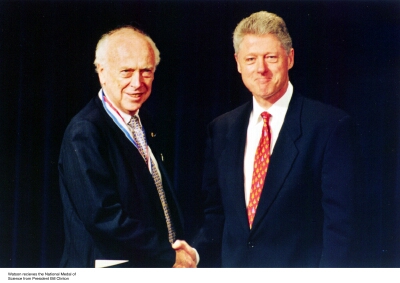
Nobel laureate James Watson, who discovered the structure of DNA with Francis Crick in 1953, came to Google to talk to us about his current work on the genetic basis of autism.

He talked first about the events of 50 years ago, a talk he had previously given to the Commonwealth Club.

He then talked about his work at the Cold Spring Harbor Laboratory on autism and genetics. He didn’t mention the recent discovery by UCLA scientists pinpointing an autism related region on chromosome 17, but he did talk about regions on chromosome 15, and several times referred to the work of Simon Baron-Cohen on fetal testosterone.

Since males have a much higher risk of autism than females, and fetal testosterone may be involved, much of the talk and even more of the questions at the end of the talk dealt with Watson’s ideas about mental differences between the sexes. He linked mathematical ability to masculinity, and said that mathematically inclined men “should marry for beauty”, since there is a higher incidence of autism in children where both parents have “masculine” traits like mathematical ability. He said he thought Rosalind Franklin may have been a high intelligence autistic, and that explained why she did not deal well with potential collaborators. He said that ex-Harvard president Laurence Summers’ comments about why fewer women become professional scientists or engineers was right, and that Summers’ only mistake was apologizing.

This unabashed lack of political correctness got a mixed reception at Google, which has a large and growing number of respected and brilliant women scientists and engineers. While the data was not questioned, the conclusions drawn came up for discussion several times during the short question and answer period that followed the talk.

Watson also talked briefly about his involvement with the Human Genome project, and Craig Venter’s shotgun approach to sequencing, which won out over the approach Watson and others originally planned for the project. He said that they had thought the shotgun approach would not be able to handle the large areas of repeats in the code, but that recent advances in computer software and hardware is making that problem less of an issue.

All in all, a surprisingly eye-opening look at a scientific icon.

Categories: Biology, Chemistry, Genetics, Health.

Tags: , , ,

Those billionaires like their alcohol

Vinod Khosla came to talk to us about his latest venture — solving the energy crisis and getting the U.S. off of our addiction to fossil fuels.

He was introduced by Eric Schmidt, and Larry Page, with Sergey Brin in the back of the room. He and Richard Branson are both investing large amounts of money in similar projects. What these five billionaires are getting excited about is ethanol.

Moonshine in the tank. Flex Fuel Vehicles running on E85 (gasohol) or straight hooch.

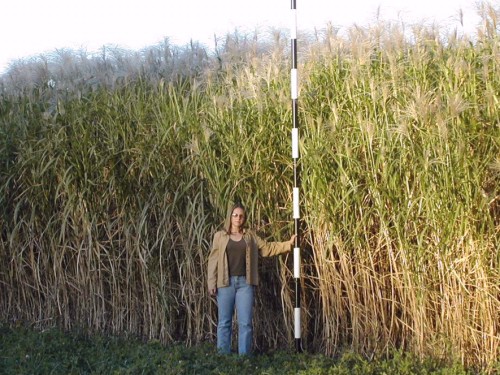
There is a long history in the U.S. of subsidizing ethanol production from corn for use in vehicles. But corn is not the most efficient base to start from — it takes one unit of energy to get 1.5 units back in the form of ethanol. But science is coming to the rescue, and new technologies are making ethanol far more efficiently, and from non-food sources, such as fast-growing switchgrass and miscanthus prairie grasses. These new technologies produce 8 times the energy they use as input.

Some of his talking points were:

  • Many cars and trucks are already Flex Fuel powered, and will run on E85.
  • Five million U.S. vehicles are already Flex Fuel vehicles.
  • 70% of the vehicles in Brazil have ethanol in the tank.
  • Brazil is saving $50 billion annually in oil import costs.
  • Ethanol is already cheaper than gasoline, without subsidies, per mile driven.
  • It costs $40 to make a car into a Flex Fuel vehicle.
  • It would take between 55 million and 114 million acres to fuel America.
  • The state of South Dakota could produce enough ethanol to be the third largest energy exporter after Saudi Arabia and Iran.
  • Farmers can make more money growing ethanol feedstock biomass than corn and soybeans.
  • Biofuels are carbon neutral.
  • The technology in this area is developing rapidly.

So, why aren’t all those 5 million Flex Fuel vehicles running on ethanol? Because the corner gas station doesn’t have an E85 or ethanol pump. Khosla suggests that Walmart should set up such pumps at every store. After all, they want people to drive to Walmart, and the product is cheaper than gasoline, both per gallon and per mile. And it is environmentally friendly. And E85 gives cars more horsepower and longer range between fillups.

Khosla would like to see two main changes to legislation:

  • Require 70% of new cars to be Flex Fuel. GM may do this even without regulations.
  • Require E85 pumps at 10% of all gas stations.

A third legislative change is designed to thwart price manipulation by oil producing countries: if oil drops below $40 a barrel, the government should buy it and stockpile it for when the price goes up again. That would stabilize world prices, and prevent the oil producers from quashing ethanol economies by temporarily removing the incentives.

The economics say this will all happen in 30 years or less, all by itself. But Khosla thinks it can be done in 5 years by a concerted effort, and people will get rich doing it.

This is the cheapest way to get solar power into cars. We can get off the oil input habit, and become a net energy exporter. We have what it takes.

Categories: Biology, Chemistry, Environment, Weather.

Tags: , , , , , ,

Cow Farts

Al Gore is coming to where I work to talk about Global Warming.

He will likely discuss human sources of greenhouse gases, such as carbon dioxide from fossil fuels, and unburned methane from petroleum production.

But he might also mention the emissions from livestock.

Now while you might expect the job of measuring these emissions would involve close study of the south end of northbound animals, it turns out that most methane emissions from cattle happen at the other end.

About one third of the 10.2 million tons of methane produced by agriculture in the European Union is produced by livestock manure, while the rest comes from belching bovines, sheep, and pigs.

On the way to becoming meadow muffins, all that grass is feeding lots of bacteria in the digestive systems of ruminants, and they convert it into methane.

Methane production is far lower in volume that carbon dioxide production, but methane is a more effective greenhouse gas, making it’s production a concern.

The search for ruminant diets that reduce methane is not just driven by concerns about global warming. All the energy in the methane is lost to poor Bossy, who could use it to produce more milk.

So the farmers are interested in better foods to boost production. Of milk, that is, not cow flatulence.

Categories: Biology, Chemistry, Environment, Weather.

Tags: , , , , ,

By Simon Quellen Field
Follow me on Google+
Find us on Google+