Skip to content

Energy costs

A friend of mine suggested at lunch that the money spent on the war in Iraq might buy a lot of solar panels.

So how many solar panels would $307 billion (at the time of this writing) buy?

My 5 kilowatt system, installed, with inverters and mounting, cost about $50,000 before government rebates. At that cost, we get 6,145,956 houses powered by solar energy. And another house gets solar for every 50 seconds the war continues (call it a house per minute).

The rule of thumb is that a house gets 6 hours a day of usable sun, so 6,145,956 * 5 kilowatts * 6 hours is 184,378,680 kilowatt hours per day.

Prior to Iraq’s invasion of Kuwait, Iraq was producing 3.5 million barrels of oil per day. In December of 2002, the U.S. imported 11.3 million barrels of oil from Iraq.

One barrel of crude oil is equal to about 1700 kilowatt hours of electricity. So Iraq was producing the equivalent of about 6 billion kilowatt hours per day. The U.S. was importing the equivalent of 620 million kilowatt hours from Iraq per day.

So, if we built solar panels with the money, we would get more than a third of the energy that Iraq supplied per day, but from the sun instead of from oil. If we continued to spend at that rate for another two wars worth of time, we would more than break even.

Now this is assuming that there are no economies of scale to be had from spending $307 billion on putting up solar panels. If there were only a factor of 3.37 in our favor, we could have effectively bought the energy equivalent of all the oil in Iraq for the cost of one war.

And, yes, the efficiency of producing electricity from oil is not 100%, (more like 40%), and there are transmission losses in the grid that you don’t have when each house is producing its own electricity, so we get our factor of 3 right there.

Joseph Stiglitz (former chief economist at the World Bank) estimates that the cost of the war on the U.S. economy is between $1 trillion and $2 trillion. Now those solar panels are looking really cheap.

So don’t blame the president’s decision to invade Iraq on the need for oil. He’d have to be stupid to have done that.

Categories: Environment, Technology.

Tags: , ,

Liquid Explosives

When airline passengers were told on August 10th, 2006, that they could no longer bring liquids aboard airplanes, the fear was liquid explosives.

Most people can probably name one liquid explosive — nitroglycerine, or more properly glyceryl trinitrate, or propane-1,2,3-triyl trinitrate. Ramzi Yousef used contact lens solution bottles filled with glyceryl trinitrate to blow up a Boeing 747 going from Manila to Japan.

But while glyceryl trinitrate is known for its dangerous instability and ease of detonation, the news reports were mentioning an even less stable chemical, triacetone triperoxide. This chemical can be detonated by a flame or by friction, but it is a solid, not a liquid. The reporters may have been confusing it with methyl ethyl ketone peroxide, which is a liquid made in basically the same way, but starting with a different organic solvent. Or they may have simply been assuming that the explosive rumored to have been used the previous July 7th was again being considered.

The news reports went on to give recipes for making TATP from hair bleach and acetone. The recipes are widely available on the web, but following the typo-laden instructions is more likely to lead to a premature death or dismemberment than a useful and transportable device. Substances that are used because they are less stable and easier to set off than military explosives are not something for amateurs to cook up from recipes on the Internet.

The drag racing fuel nitromethane can be sensitized with alkalies to become more easily detonated. Nitroethane is another liquid that can be coaxed to explode. The explosive dithekite has also been mentioned, but none of these is as easy to make in a kitchen as TATP, and none are as easy to detonate.

Methyl nitrate is another, but it has an odor that would cause suspicion (and headaches). Another liquid mentioned in the news reports is Fixor, whose web page mentions that it can be carried aboard passenger airplanes (not anymore, I suspect!).

The reason for using liquid explosives is that the X-ray machines and other devices for detecting explosives rely on density and other properties of solid explosives, and liquids explosives look like innocuous ordinary liquids to them. I suspect that peroxide explosives might have passed through sniffer detectors that were designed to detect nitrate based chemicals, but newer detectors are sure to catch them.

Categories: Chemistry, Technology.

Tags: , , ,

On Food and Cooking

Yesterday I had lunch with Harold McGee. He is the author of the classic book on the chemistry of cooking, titled “On Food and Cooking”. Lunch was great — we ate with the head of Google’s many cafes, and with the chef, the Google doctor, the Google nutritionist, and some special guests.

The conversation was about food, chemistry, writing, the ten years of writing and research that culminated in the book, the new second edition, book tours, book signings, abalone (the chef had prepared a special plate of delicacies), and teaching. I’m sure I left something out.

Long after lunch, I was walking past a lounge area and heard my name shouted. Harold was sitting on a couch in conversation, having finished his tour of the Google campus, but apparently not yet ready to leave, even though it was approaching 3 in the afternoon.

I joined him, and the talk turned to web sites.

He has a very pretty website http://curiouscook.com, with biographical information and excerpts from the books, but not a huge pile of content. But he has collected a book’s worth of miscellaneous gems of knowledge about food and cooking that just didn’t fit into any nice categories. Besides, On Food and Cooking was already 896 pages long.

The answer, of course, was to publish this information on the web site, where it will be a magnet for visitors interested in cooking, chemistry, food, and how they all fit together. We discussed some ways to organize and present it, and to get the work into the right form. We talked for over an hour, and I was almost late for my next meeting.

So, keep an eye on his web site — there is likely to be a flood of fascinating new information coming soon.

Categories: Biology, Chemistry, Food, Health.

Maker Faire

Yesterday I went to the Maker Faire in San Mateo. The publishers of Make magazine pulled together a whole bunch of gadgeteers and inventors to show off their projects at the fairgrounds.

There were propane flame cannons booming away, plug-in Prius conversions, and a supercomputer built from recycled PCs.

Yahoo! had a large booth, and the Wondermagnets booth was demonstrating my Gauss Rifle.

I met several people I know there. Marius Milner, author of NetStumbler was there with two kids, and while we were chatting my old friend Brad Templeton astonished my wife by remembering her name (we all worked together in 1980 at the company that became VisiCorp). And I finally got to meet Bill Gurstelle, author of Backyard Ballistics, who reviewed my book Gonzo Gizmos, and is quoted on the back cover. He was demonstrating how to build a spud gun.

There were lots of remote controlled battle bots, showing their scars from competition, lots of computer projects, autonomous robots, and electric cars like the Xebra. There was a big black bus in one of the exhibit halls, and people were encouraged to build little LED lights with magnets on them, and throw them at the bus as an art piece. There was even a band playing, trying to be heard over the roar of propane cannons, the whine of computer controlled routing machines carving wooden artwork, and vegetable-oil fueled generators for the supercomputer built from scrap.

And all throughout the huge fair, kids were building gadgets, or playing with armfulls of helium foam. Definitely an event not to miss.

Categories: Computers, Physics, Technology.

Tags: , , ,

Supercar

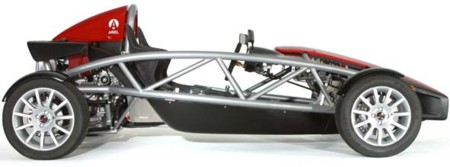
Yesterday I got to ride in Ian Wright’s electric supercar, the Wrightspeed X1. In 3 seconds, we went from stopped to 60 miles per hour, and kept accelerating. By the time 8 seconds had gone by, we were moving at over 100 miles per hour. My stomach tightened, my fingers gripped the tubular steel frame for dear life, and we kept accelerating at nearly a full G. Finally, we slowed down, turned around, and the whole terrifying ride started again.

It isn’t the speed that terrifies you. It is how fast you get to that speed. Your brain doesn’t have time to get used to it. The X1 is better than any rollercoaster ride for getting the adrenalin going.

The car runs on $40,000 worth of Lithium Polymer batteries. Driving in a sane manner, it will go for 125 miles on a charge. But nobody buys a car like this to drive sanely. But it will do 100 of those quarter mile races before needing to be plugged in. That’s a lot of adrenalin.

Ian Wright did the driving, and he built this prototype by hand for about $150,000. But he calculates he can make money selling production versions for $100,000 each.

Categories: Environment, Physics, Technology.

By Simon Quellen Field
Follow me on Google+
Find us on Google+