Skip to content

Vioxx and Bextra and Lawyers, Oh My!

The news has been full of reports recently about health problems related to Vioxx, Bextra, Celebrex, and other cox-2 inhibitor pain killers. Personal injury lawyers are putting up ads all over the place to drum up business. Do a Google search for any three of those names and the page will be full of lawyers advertising for clients.

So what is all the fuss really about?

These drugs are nonsteroidal anti-inflammatory drugs, or NSAIDS. NSAIDS include Bextra, Mobic, Ibuprofen, Daypro, Naprosyn, Celebrex, and Vioxx, and aspirin. Over 50 different NSAIDS are currently available in the U.S.

Aspirin, of course, has been used for years for headaches, arthritis, general pain relief, and fever reducing. But aspirin can cause bleeding in the digestive system. When Vioxx was invented, it was marketed as an alternative that was safer. Then Celebrex and Bextra came along, but they turned out to be no safer than aspirin for the stomach.

The new drugs target an enzyme called cyclooxygenase-2, more commonly abreviated as COX-2. The hormone prostaglandin is a major regulator of pain and inflammation. It is produced in the body from the omega-6 fatty acid arachidonic acid. Enzymes convert arachidonic acid into prostaglandins, thromboxanes, prostacyclin and leukotrienes, all important bioactive substances. The enzymes that do this include cyclooxygenase, lipoxygenase, and peroxidase.

NSAIDs generally work by inhibiting cyclooxygenase. The problem is that there are several prostaglandins that are inhibited, not just the ones that regulate fever and pain. The prostaglandins that are responsible for the protective mucus lining in the stomach and intestines are made using one form of cyclooxygenase (COX-1), and the prostaglandins that are responsible for pain and inflammation are made using another form (COX-2).

So, pharmaceutical companies set out to make substances that would inhibit COX-2 without interfering with COX-1, so there would be less damage to the protective mucosal lining in the gut. Vioxx came along, and was followed by 50 others. People got rich.

Aspirin is also known to have protective effects against heart disease, through a number of mechanisms, one of which is reducing inflammation. In studies on the new COX-2 pain killers, when comparing them to Naproxen sodium (Naprosyn), it was found that Naprosyn had fewer bad effects on the heart than the newer drugs. At first this was attributed to Naprosyn having aspirin-like protective qualities for heart disease. But after more study, it came out that some of the new COX-2 inhibitors were actually causing problems.

That’s when regulators and lawyers came in, followed by news reporters, and more lawyers.

So now you know.
Categories: Biology, Chemistry, Food, Health.

Tags: , , , , , ,

Making a quick buck

I got a chance to talk to John Morgan today about an experiment he ran at the Haas School of Business at UC Berkeley.

His experiment set out to see if there was a benefit to sellers to switch between eBay and Yahoo! auction sites. Among several interesting points, it came out that sellers could make 29.7% more money on eBay for the same items, with the same descriptions, from the same seller with the same reputation.

One of his conclusions is that eBay is becoming a monopoly, and this is evidence of “tipping” towards that state.

So I asked the question — If someone can buy things at Yahoo! and sell those things on eBay and make an immediate 30% profit, why aren’t there arbitragers making money that way, and flattening out the markets? The answer was that the information was not widely known, and so the arbitragers weren’t there yet.

The next question was — Wouldn’t it be in Yahoo!’s best interest to make this widely known, so that the tipping towards an eBay monopoly would be thwarted, and Yahoo! would make more money, and the end users would benefit from competition?

Of course Dr. Morgan could not speak for Yahoo!, but seemed to agree that it would be in their interest to make his work a best seller.

So, all of you auction site site users, and all of you who are quick with the occasional Python script, do yourself and Yahoo! and possibly the world a favor, and help stamp out a burgeoning monopoly, and get a 30% return on investment right away.

Categories: Computers.

Tags: , , ,

Big useless telescopes

Now that even the last holdouts are admitting that global warming is real, and is largely the result of human activity, we can look at the effects of climate change on human activity.

Much of the concern has rightly been about losing coastal areas where most of the human activity takes place, or would like to. The effects on food production, weather, and biodiversity have gotten much attention.

But what caught my attention recently was something of less economic impact, but disturbing nonetheless. A synergistic combination of increasing jet aircraft contrails and global warming. each increasing the other, will increase cloud cover so much by 2050 that earth based telescopes will become useless.

People around the globe are working hard to build extremely large telescopes of over 100 meters in diameter. But all that work may have a short-lived benefit if the telescopes can’t see through the clouds a decade or two after they are built.

Categories: Astronomy, Environment, Physics, Weather.

Tags: , , , , ,

The Sunshine Vitamin Fights Cancer

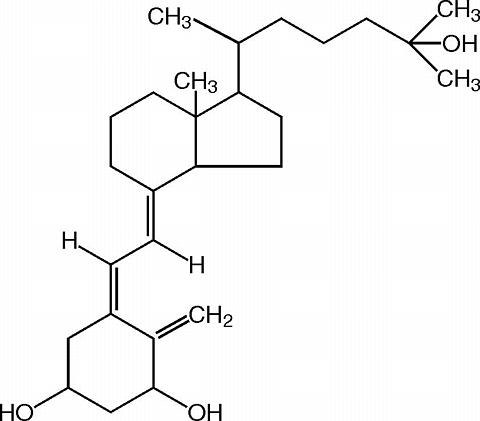
Calcitriol

The sunshine vitamin is Vitamin D.

Vitamin D comes in several forms. One of them is a steroid hormone known as Calcitriol or less commonly by its cute nickname 9,10-seco(5Z,7E)-5,7,10(19)-cholestatriene-1a,3 b ,25-triol.

Your skin contains a substance called 7-dehydrocholesterol. Ultraviolet light from the sun converts this into Vitamin D3, also known as cholecalciferol.

Cholecalciferol is brought by the blood to the liver, where is it converted into the cleverly named 25-hydroxyvitamin D 3 [25-(OH)D 3 ] by a liver enzyme. This is brought to the kidneys by the bloodstream, where it is converted into calcitriol by the kidney mitochondia.

Vitamin D is most famous for its action in the intestines, where it is essential for the absorption of calcium, making the mineral available to form bones. The lack of Vitamin D causes the bone disease rickets.

But what has caught my attention is the lesser-known effects of Vitamin D on cancers, such as colorectal cancer, prostate cancer, breast cancer, ovarian cancer, non-melanoma skin cancer, and malignant melanoma. These last two in interesting, since the same ultraviolet light from the sun that creates Vitamin D also causes skin cancer. But occupations that give workers more sunlight seem to protect agains all of these cancers, especially breast and colon cancers.

So, people who are slathering on sunblock and avoiding sun exposure to prevent skin cancer are also eliminating a source of a substance known to help fight cancer. The good news is that various forms of Vitamin D are available in dairy products and vitamin supplements.

And guess what the two most common forms of cancer are in the United States? Skin cancer, and prostate cancer.

Drink your milk folks. And a vitamin pill might also help.

Categories: Chemistry, Food, Health.

Tags: , , , , , , , ,

Building a better brain

There is a class of proteins in the brain called neurotrophic factors.

Two of them are particularly interesting to me at the moment. They are GDNF and BDNF. What interests me about them today is that they are produced in the body as a result of exercise, such as walking for an hour a day.

The effects of BDNF and exercise are an increase in brain cells, and an increase in the branching of the brain cells that contribute to brain function and memory.

One researcher, Carl Cotman, refers to BDNF as “brain fertilizer”. Rats and mice that are allowed to exercise as much as they like perform much better on memory tests than sedentary rats and mice, and their brains show much higher levels of connectivity.

The other protein, GDNF, protects brains from Parkinson’s disease, Alzheimer’s disease, and Amyotrophic Lateral Sclerosis (ALS).

So why am I interested in these proteins today? Thursday is the day of the Google Weekly Walk. A bunch of us Googlers meet in the building 42 lobby at 3:00 pm, and then take an hour long walk around the lake by the golf course.

It’s a beautiful walk by the stream and the little lake, and you get to talk to very smart people about just about anything, people who you might not otherwise have any occasion to talk to.

And you build a better brain at the same time…

Categories: Chemistry, Health.

Tags: , , , , , , , , ,

By Simon Quellen Field
Follow me on Google+
Find us on Google+