Skip to content

Thermal Mass Extinction

I wrote a piece a couple years ago about how ocean pH levels are expected to get more acidic as more carbon dioxide is absorbed in the water. A more acidic ocean would mean trouble for organisms that form skeletons from calcium carbonate.
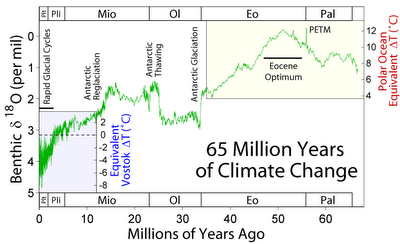
But while carbon dioxide levels in the atmosphere are higher than they have been in the last 420,000 years, scientists such as Yale’s Mark Pagani are finding evidence of carbon dioxide levels five times as high as today’s levels, when they look at ocean drilling cores dating back to over 50 million years ago.
That period was the warmest of the last 65 million years. It is the period when the first mammals were taking over, following the Initial Eocene Thermal Maximum, a period of global warming lasting 20 to 100 thousand years, warming the high latitudes by up to 7 degrees Celsius. It was a strong extinction event. The polar regions had climates similar to the Pacific Northwest, and tropical climates extended to what is now the U.S. Canadian border.
The main suspect for the cause of this temperature spike is the destabilization of marine clathrates. These are ice-like compounds made from methane and water. When they warm up, they release methane, a potent greenhouse gas. There is a whole lot of this stuff on the ocean floor, and if something causes them to release methane into the atmosphere all at once, we can expect temperatures to rise very suddenly. During the Thermal Maximum, an estimated 2 trillion tons of methane was released into the atmosphere.
What is important for marine organisms with shells of calcium carbonate is something called the lysocline. Shallow waters are supersaturated in calcium carbonate, so the shells don’t dissolve. But deeper in the water the saturation decreases, until a point is reached where calcite and aragonite (the minerals the shells are made of) dissolve. Evidence from ocean drilling cores shows that during the Paleocene/Eocene Thermal Maximum 55 million years ago, the lysocline rose by half a kilometer.
The current lysocline depth is about 4.5 kilometers in the Pacific, and 5.5 kilometers in the Atlantic. So shallow water organisms will still retain their ability to make shells and coral reefs. In fact, coral reefs grew in the warm waters of the Eocene Optimum, when the polar ice was melted, and the thermal expansion of the oceans caused sea levels to rise. When plate tectonics joined North and South America at Panama, and ocean circulation patterns changed enough to cause reglaciation, sea levels fell, and the erosion of those coral reefs added calcium carbonate to the oceans, causing the lysocline to fall over a kilometer.
So the oysters will probably survive. But what species dominates the land after the next thermal mass extinction is less certain.

Categories: Biology, Chemistry, Environment, Geology, Weather.

Tags: , , , , , , ,

Not as we know it

I had lunch yesterday with Steven Benner.

The last time we talked had been in August of 2007, and the discussion centered around his work in synthetic biology — creating DNA strands with 12 nucleotides instead of 4, and proteins with more than 20 amino acids.

This time, he was here for the Astrobiology Science Conference to talk about life on other planets. But he took the time to visit Google to talk about his recent project, generating tools and techniques to cheaply and quickly find the genetic differences between a patient and a “reference genome”, such as the one generated by the Human Genome Project.

By pulling out only the differences between two people, this approach can dramatically shorten the time needed to sequence a person’s DNA, and reduce the cost accordingly. He estimates he can show how your DNA differs from Craig Venter’s DNA for about $35,000. Since we know Venter’s DNA from the Human Genome Project, knowing the differences gives us a complete picture of your DNA.

The talk intertwined with several of his other research interests, touching on his work using synthetic DNA to make diagnostic tests for HIV and hepatitis, his explorations into structural biology and experimental paleogenetics, and bioinformatics.

At lunch after the talk, the discussion ranged even more widely, as we toyed with solutions to problems of drug regulation, drug resistance in microbes, paleolithic diets, global warming, and species extinctions.

This is definitely someone I will want to talk to again — there seemed to be new ideas in every sentence.

Categories: Biology, Chemistry, Genetics, Technology.

Tags: , , , , ,

What Snail Is This?


While walking at Mountain View’s Shoreline Park I came across a type of land snail I had never seen before.

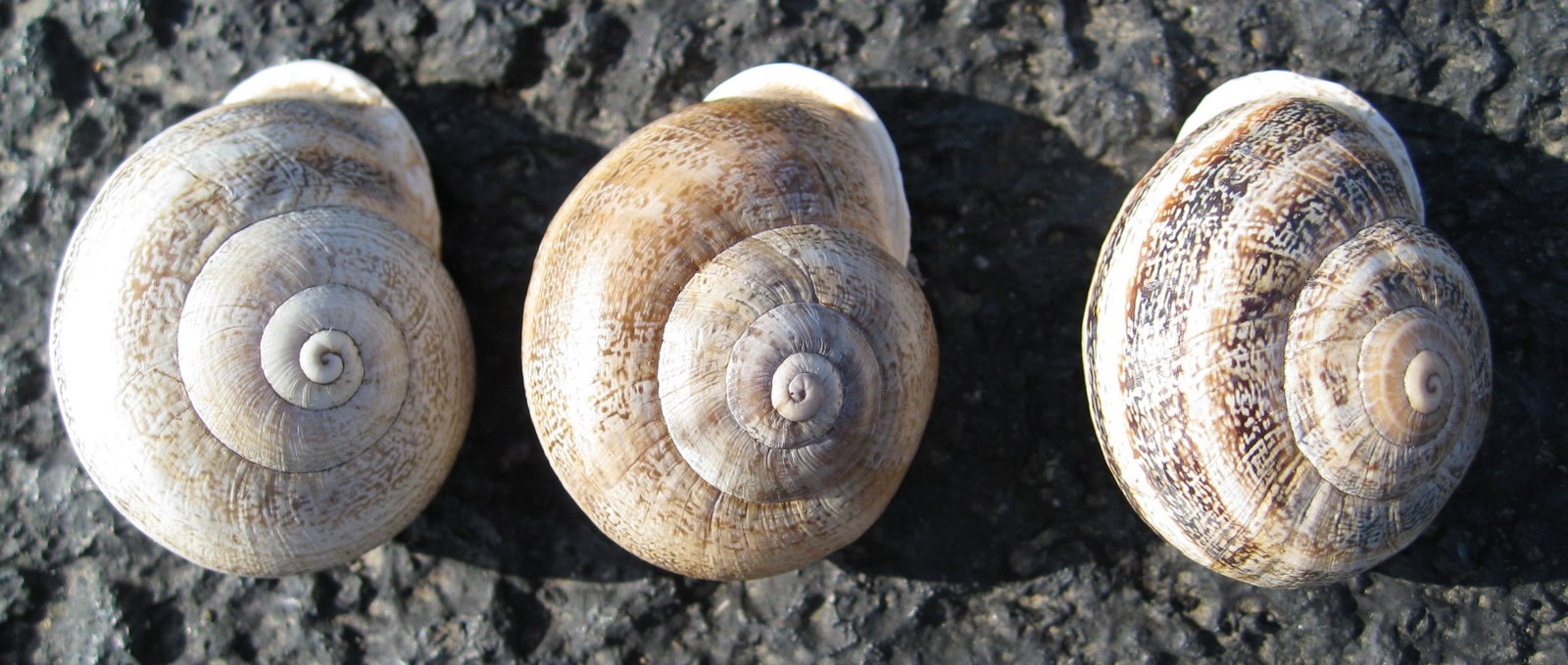
At first I thought it was a common European Brown Snail that was somehow bleached white or covered with some kind of salt deposit. Shoreline Park is, after all, at the shore. But after close examination I became convinced that this was a different type of critter altogether. It was naturally whiter than the snails I was used to seeing farther inland, and seemed a bit flatter (less pointed), and inside, it had a dark stain on the shell.

After some searching on the web, I tentatively identified it as possibly a Milk Snail (Otala lactea). Readers who view the photos and have a positive identification are eagerly invited to send me email or comment on this article.

But as most web searches do, this one led to more questions, and more browsing. Many sources mentioned the introduction of the European Brown Snail (Cantareus aspersus) to California by a Frenchman in or around 1850. Others disagreed, or had variously different versions of the story. But nowhere could I find information on who the Frenchman was, or a definitive source for the story.

I often ask my friends at Google for examples of things that are difficult to find using a web search. This has become something of a game. So here was one example staring me in the face. Who started the story about the Frenchman importing escargot to California, only to end up dumping them into a river?

The story seems to be one of those where you can tell it is suffering from “telephone game” distortions after being told too many times. Once source claims the snails were dumped in the Santa Clara River in Northern California. But that river is in Southern California. Another source claims that if San Franciscans wouldn’t eat them, he concluded no one would. Another says the market for snails during the Gold Rush was “too unsophisticated” to eat common garden pests.

One reference in Google Books cites an author Forbes writing in 1850, and another, Stearns, writing in 1900. It is this last reference where I hit pay dirt.

Robert Edwards Carter Stearns (1827-1909) tells of a Mr. A. Delmas, of San Jose, California, who brought a stock of European Brown snails to a vineyard on the west bank of the Guadalupe river in the Santa Clara valley (what we now call “Silicon Valley”). Stearns notes that the valley was settled by “a few French families”, and that the introduction of the snail was ‘with an eye to the pot’. By 1900, the snails had crossed the river to the east side, and were becoming a nuisance in gardens.

The snails were also planted in San Francisco and Los Angeles by the elder Mr. Delmas, but Stearns could not find any in San Francisco, concluding that the weather and drifting sands in that city in 1860 would be inhospitable. Things had changed by 1900, and he thought they would “find a congenial environment in Golden Gate Park” if they were ever brought there. They were already a problem in Oakland at that time, and in Elysian Park in Los Angeles.

It is now about 150 years after Mr. Delmas released the critters in San Jose. There seem to be few places I have visited in California where they are not a common garden pest, if you live in a city. Where I live, a few miles away from San Jose, they are absent — I live on a mountain, surrounded by steep dry hills. But in the houses at the base of the mountain, a constant battle between mollusc and man goes on.

Categories: Biology, Environment, Food.

Tags: , ,

Science Foo


This weekend I got to meet with hundreds of amazing people at the O’Reilly/Nature/Google event called Science Foo (short for Friends Of O’Reilly). The discussions in the conference rooms were fascinating, but the discussions one-on-one or in small groups during breaks were even better.

Some of the attendees I had met before, or even known well, such as Theo Gray, Chris Dibona, Sergey Brin, Peter Murray-Rust, Dean Kamen, Josh Bloch, Tim Hubbard, Vinod Khosla, and Larry Page, but most others were people I had only read, or read about.

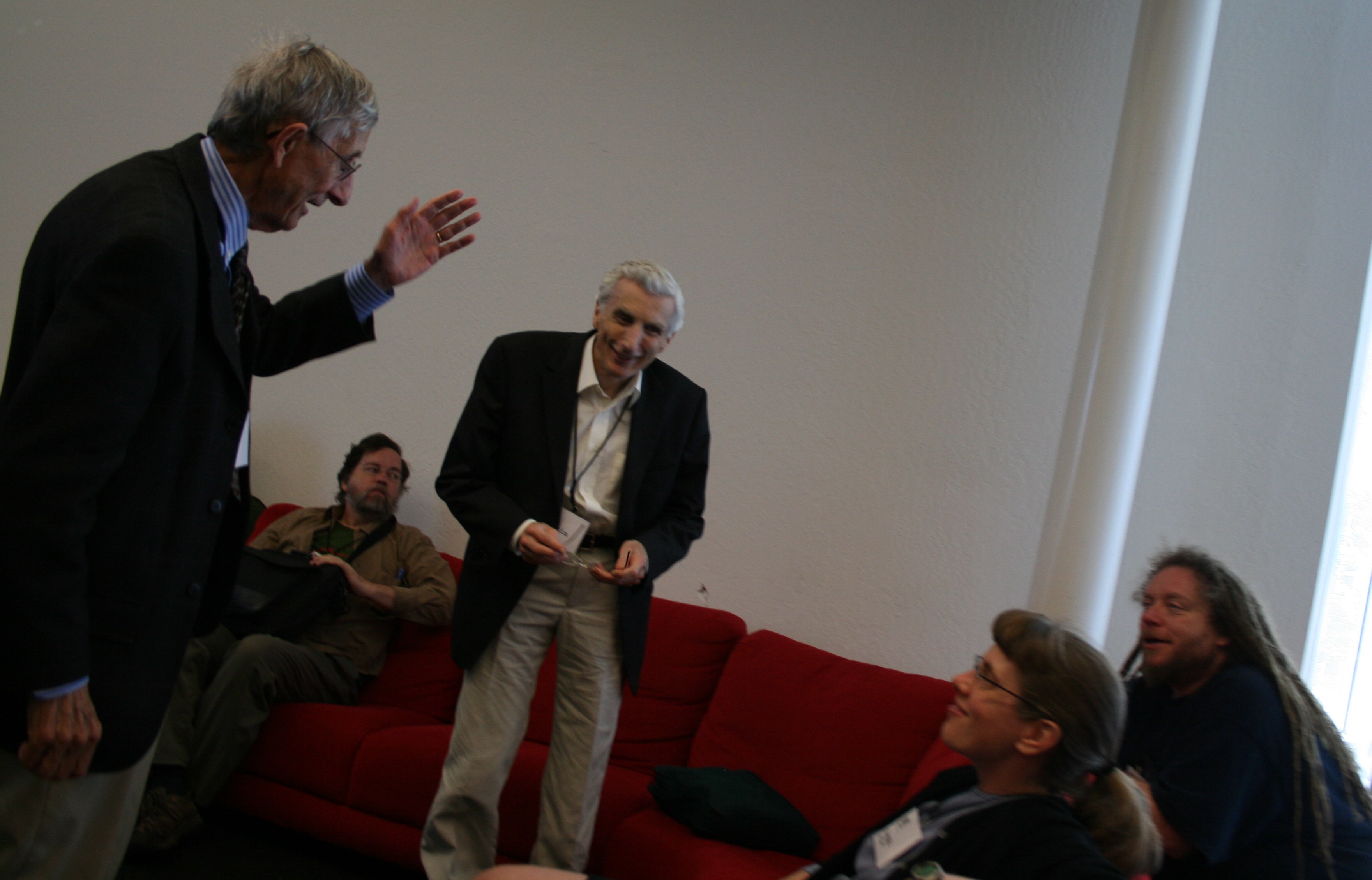
The photo above shows Freeman Dyson, Sir Martin Rees, and Jaron Lanier. More photos here.

Steve Benner led or spoke at several marvelous discussions about synthetic biology and issues relating to recombinant DNA research and biohacking, along with Roger Brent (who had some interesting applications for the ultraviolet LEDs I was handing out).

Henry Gee led a discussion on science fiction, attended by Kim Stanley Robinson, Neal Stephenson, and Greg Bear, during which we found that many of the scientists in the audience were also writers of science fiction.

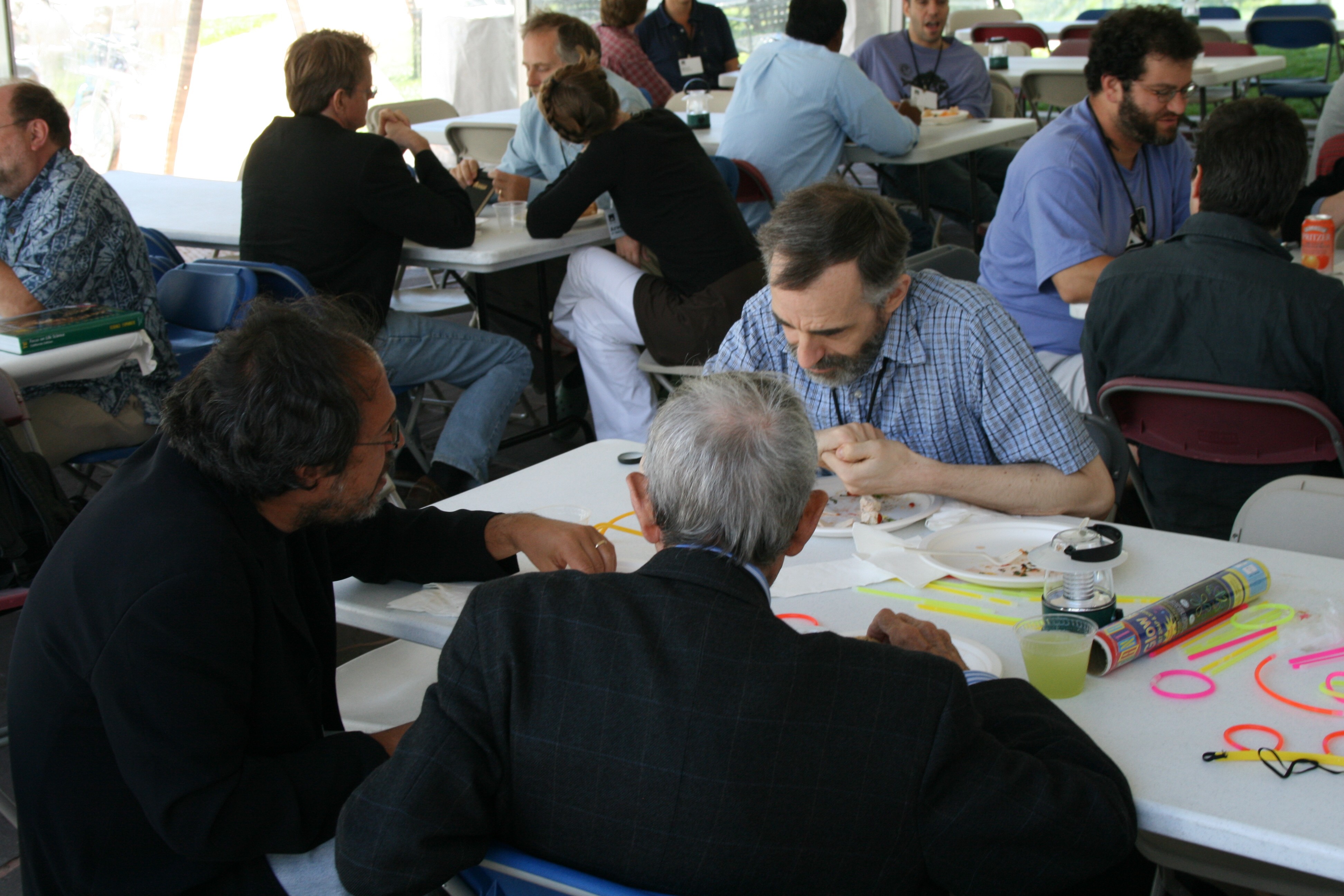
If you see people in the photos wearing light sticks from scitoys.com, that’s because I brought a few hundred of them and passed them around. People got very creative with them.

Charles Simonyi talked about his recent tourist visit to the International Space Station, and Martha Stewart stood up during his talk to tell us about making meals for him to take up into space.

And I finally got to thank Martha Stewart in person for getting my company off to a big start — a large order of my Film Can Cannons helped “start her company off with a bang” at the IPO party for MSLO, and was the first big order for scitoys.com.

Eric Drexler, Lee Smolin and Freeman Dyson play with light sticks from scitoys.com.

Categories: Computers, Physics, Technology.

Tags: , ,

Yellow faced bumble bee

This morning while walking I noticed a European honeybee on a mustard flower. Mustard is not a native California plant, although it has become extremely widespread. On the California poppies nearby, a different kind of bee was busy, a large black bumblebee with yellow stripes. I wondered if the bee was as native as the poppy to my Northern California farm.
It took some sleuthing to come up with a name for the little guy. I think it is a Yellow faced Bumble Bee, Bombus vosnesenskii, but I am not an expert. Of the 30 species of bumblebee listed at bugguide.net, this one looked the most like the ones in my photos. It is possible it is a Bombus caliginosus.
I had taken a lot of photos. This particular bee does not seem to stay in one place very long, and it was quite difficult to get shots without motion blur or focusing problems.
The bee is definitely native to my area. The range seems to extend from Baja California to Alaska, and as far east as the Rocky Mountains.
So, I had found a European bee on a European plant, and a California bee on a California plant. This got me to thinking about invasive native species, and efforts to control them. If some invasive species are mostly pollinated by bees from their home area, removing those bees might help control the pest plants. Instead of removing the weed, the flowers could be sprayed with an insecticide. Then they would no longer get pollinated, and no longer spread.
Of course this kind of control has many problems associated with it. There would be collateral damage. Some native bees would be killed. People who raise honeybees for honey would probably object. And the process would be slow, as we are simply making it a little harder for the plants to crowd out the native species.
But the other side of the coin is encouraging native bees by removing the competition from European honeybees. By removing non-native plants that are pollinated only by honeybees, the honeybees would go where their favorite plants are, and the native bees would have the native plants to themselves. More native bees pollinating native plants leads to more native plants. Perhaps.
Keep your eyes open while you walk around your garden or past an open field. Ask yourself questions about what you see, and follow up with a little research. You never know what you’ll learn that way.

Categories: Biology, Environment.

Tags: , , ,

By Simon Quellen Field
Follow me on Google+
Find us on Google+